


Green and Blue Tattoo Removal: Why These Colors Are Misunderstood and How to Remove Them Safely

Subscribe to receive the latest Insights
Thank you! Your submission has been received!
Oops! Something went wrong while submitting the form.
Follow Us
Green and blue tattoos have a reputation for being “impossible” to remove. Many clients are told they will need 15 or more sessions, that their tattoo will never fully fade, or that certain colors cannot be removed at all.
In reality, green and blue tattoos are often very manageable when the correct wavelengths, laser technology, and protocols are used. The biggest reason clinics struggle with these pigments is not because green and blue ink is inherently unremovable, but because many providers are using outdated technology, limited wavelength options, or overly aggressive settings that create complications in later stages.
At INKLESS, we remove green and blue tattoos every day using a multi-laser approach that allows us to customize protocols for each tattoo’s pigment chemistry and skin type.
Why Green and Blue Tattoos Can Be Challenging
Green and blue pigments can be more complex than black ink because they often absorb laser energy less efficiently. Black pigment absorbs across a wide range of wavelengths, which makes it highly responsive to laser treatment. Green and blue pigments are lighter and more selective in their absorption behavior, which means they require more specific wavelengths to break down effectively.
The challenge increases when green or blue pigment contains additives such as titanium dioxide or when the ink is blended with other tones like yellow or white.
This is why two tattoos that look similar in color can respond completely differently during removal.
The Hidden Problem: Yellow and White Pigments in Green Tattoos
One of the biggest variables in green tattoo removal is whether the green ink contains yellow or white pigment.
Green tattoos are often created by blending pigments rather than using a single pure green compound. If the green contains a significant amount of yellow, removal becomes more difficult.
Yellow is widely considered the most challenging tattoo color to remove because it refracts light rather than absorbing it. Unlike most pigments, which absorb laser energy and break down, yellow often reflects laser wavelengths, making it resistant to fragmentation.
White pigment, commonly titanium dioxide, also creates difficulty because it scatters light instead of absorbing it. Titanium dioxide can reduce removal predictability and can contribute to long-term residue.
If a green tattoo has heavy yellow or titanium dioxide mixed in, full removal may be less predictable. However, it can still often be significantly lightened for a clean cover-up.
Why Many Clinics Struggle With Green and Blue Ink
Most clinics that struggle with green and blue tattoos are limited by one of two problems:
- They are using older laser technology
- They do not have access to the correct wavelengths
Many large chains rely on one laser system for every tattoo regardless of color, pigment blend, or skin tone. While this may work well for black ink, it often produces slower results with color tattoos.
In addition, some providers rely on wavelengths that are not ideal for green and blue pigment and may actually increase the risk of pigment oxidation or skin complications when used aggressively.
Wavelengths We Recommend Avoiding for Green and Blue Tattoos
Certain wavelengths have historically been used for color tattoo removal but often lead to poor efficiency and higher complication risk, especially in later stages.
We recommend avoiding lasers that rely heavily on:
- 694 nm
- 650 nm
- 585 nm
These wavelengths can require excessive sessions, often 15 or more, and may push providers into overly aggressive treatment settings in order to continue producing results.
In some cases, these wavelengths can also oxidize pigment ingredients or leave behind discoloration that becomes increasingly difficult to clear.
This is one of the main reasons clients are sometimes told their tattoo is “stuck” after years of treatment at other clinics.
The Best Wavelengths for Green and Blue Tattoo Removal
Green and blue tattoos respond best when treated with modern pico and nano technology using wavelengths designed specifically for those pigment absorption curves.
At INKLESS, the strongest wavelengths for green and blue removal include:
785 nm Wavelength
The 785 nm wavelength is one of the most effective options for green ink removal and is also excellent for many blue pigment blends.
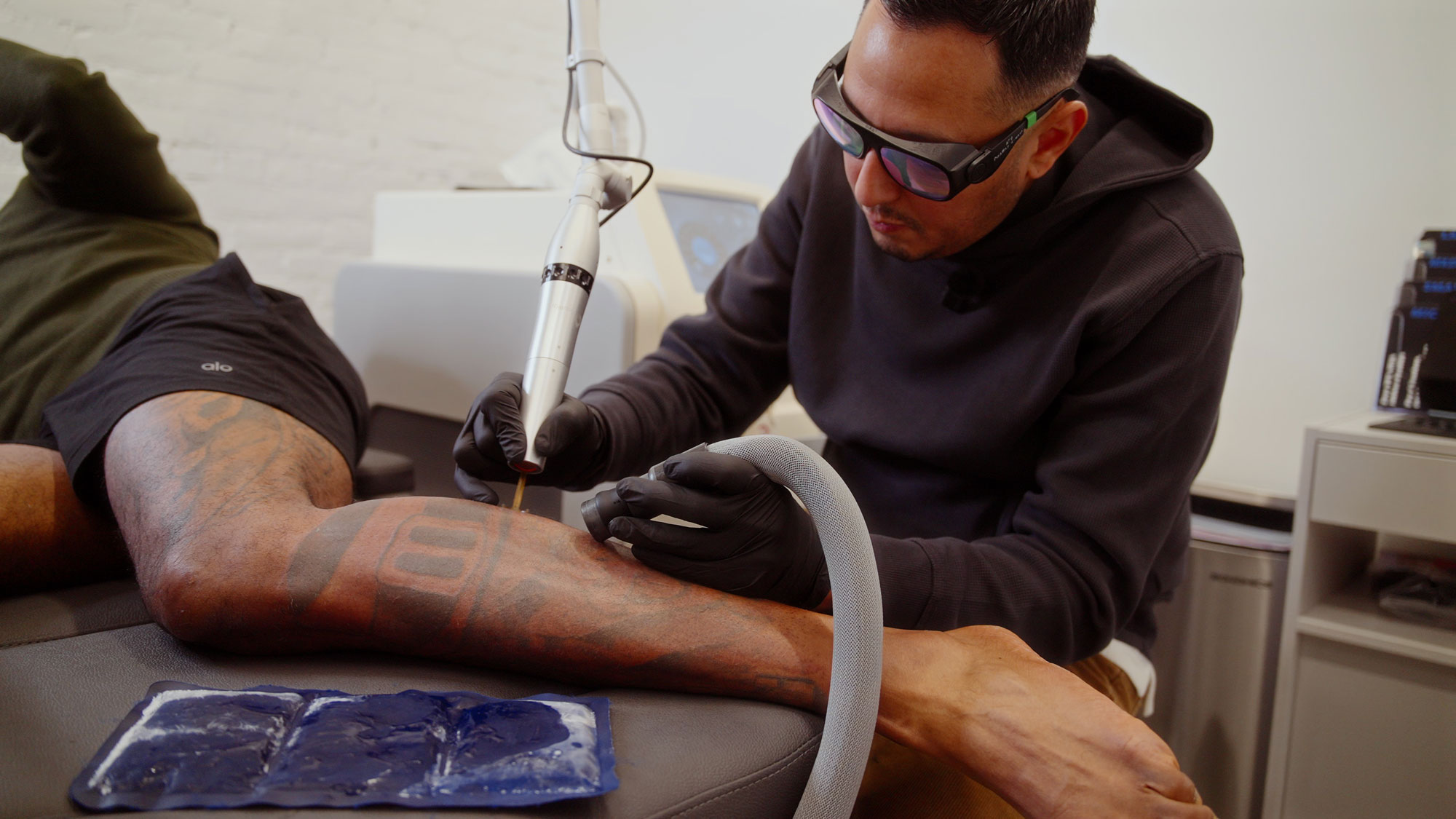
The Helios785 Pico platform is particularly effective because it combines strong wavelength delivery with both pico and nano pulse capabilities, allowing the treatment to be adjusted depending on the tattoo’s stage of fading.
670 nm Wavelength
The 670 nm wavelength is a powerful option for certain blue pigments and transitional tones that do not respond well to traditional wavelengths.
The Cutera Enlighten III is one of the best systems for delivering 670 nm effectively, and it is often used when tattoos have been previously treated or have pigment residue that is resistant to standard protocols.
730 nm Wavelength (Useful but Not Always Enough Alone)
The PicoWay 730 nm wavelength can work well on certain greens and blues, but it is often not enough to complete removal by itself.
In later stages, relying on 730 nm alone can require aggressive settings, which increases the risk of hypopigmentation if the area is over-treated.
For best results, the 730 nm wavelength is often used in combination with 670 nm or 785 nm to safely finish the tattoo without excessive trauma.
Why INKLESS Gets Better Color Results: Multi-Laser Protocols
At INKLESS, we are one of the few clinics using a true multi-laser approach for color tattoos.
We do not rely on one machine for every pigment type. Instead, we customize each protocol based on the tattoo’s color composition, depth, saturation, and the client’s skin tone.
Our laser systems include:
- Helios785 Pico (785 nm for greens and blues)
- Cutera Enlighten III (670 nm for blues and difficult pigment blends)
- Candela PicoWay (strong for multiple pigments including green, blue, and black)
This gives us access to over eight wavelength options and multiple treatment modalities, allowing us to adjust the treatment plan as the tattoo evolves through each stage of fading.
This is critical because tattoo removal is not linear. The pigment response changes as the tattoo lightens, and protocols must evolve accordingly.
Color Tattoos vs Black Tattoos: Which Is Actually Harder?
Many people assume black tattoos are always the easiest to remove. While black pigment absorbs laser energy extremely well and has a high success rate for full removal, the reality is more complex.
Black tattoos can sometimes take longer than certain colors because:
- Black linework is often heavily saturated
- Black pigment is frequently applied deeper in the dermis
- Newer black tattoos contain more pigment volume
- Older black tattoos can settle deeper over time
This means black tattoos can still require several additional treatments compared to certain reds, purples, or even some blues and greens.
The true difficulty is not simply “black versus color.” The real challenge is pigment density, depth, and chemical composition.
Why Yellow Is Still the Hardest Color to Remove
Among all tattoo colors, yellow remains the most difficult pigment to remove.
This is because yellow pigment:
- Refracts light rather than absorbing it
- Is often heavily saturated by artists for visibility
- May contain cadmium or iron oxides
- Has a high molecular weight that can settle into tissue
Even with the best lasers available, yellow pigment is often the least predictable color for full removal.
However, most yellow tattoos can still be lightened significantly, and many can be improved enough to allow for a clean cover-up design.
Titanium Dioxide and Why Some Color Tattoos Leave Residue
One of the most important variables in color tattoo removal is the presence of titanium dioxide.
Titanium dioxide is commonly found in:
- white pigments
- pastel blends
- cosmetic tattoo pigments
- certain greens and blues
- flesh-tone camouflage blends
This ingredient does not absorb laser energy effectively. Instead, it scatters light, which makes removal slower and sometimes incomplete.
In some cases, titanium dioxide can also oxidize and darken during treatment, which requires specialized protocols to correct.
This is why pigment composition matters more than tattoo color alone.
Realistic Expectations: Full Removal vs Lightening for Cover-Up
One of the most important parts of ethical tattoo removal is transparency.
Not every tattoo can be guaranteed full removal, especially when pigments are heavily blended, contain titanium dioxide, or include resistant colors such as yellow.
However, even when full removal is not achievable, most tattoos can still be lightened dramatically. In many cases, we can fade a tattoo enough to allow a clean, high-quality cover-up without requiring the artist to oversaturate or compromise placement.
At INKLESS, we never promise complete removal unless we truly believe it is achievable and supported by science.
Final Thoughts
Green and blue tattoos are not impossible to remove. With the right wavelengths, modern pico technology, and proper protocols, they are often very manageable.
The biggest obstacles are outdated equipment, limited wavelength options, and overly aggressive treatment approaches that can lead to complications in later stages.
At INKLESS, we use a multi-laser approach with advanced systems such as Helios785 Pico, Cutera Enlighten III, and PicoWay. This gives us access to over eight wavelength options and multiple treatment modalities, allowing us to customize protocols and often reduce the total number of sessions needed.
If you have a green or blue tattoo and have been told it cannot be removed, the best step is to schedule a consultation so we can evaluate the pigment composition, skin type, and fading potential and provide a realistic plan based on your tattoo’s unique variables.
Related Insights

Let’s talk
Have a question about your tattoo or curious about your options? Send us a message and one of our experts will personally guide you toward the safest, most effective next step.
720-465-5377
Thank you! Your submission has been received!
Oops! Something went wrong while submitting the form.
