


Limitations of Multiphase Tattoo Removal Methods (R20 & PFD Pads)

Subscribe to receive the latest Insights
Thank you! Your submission has been received!
Oops! Something went wrong while submitting the form.
Follow Us
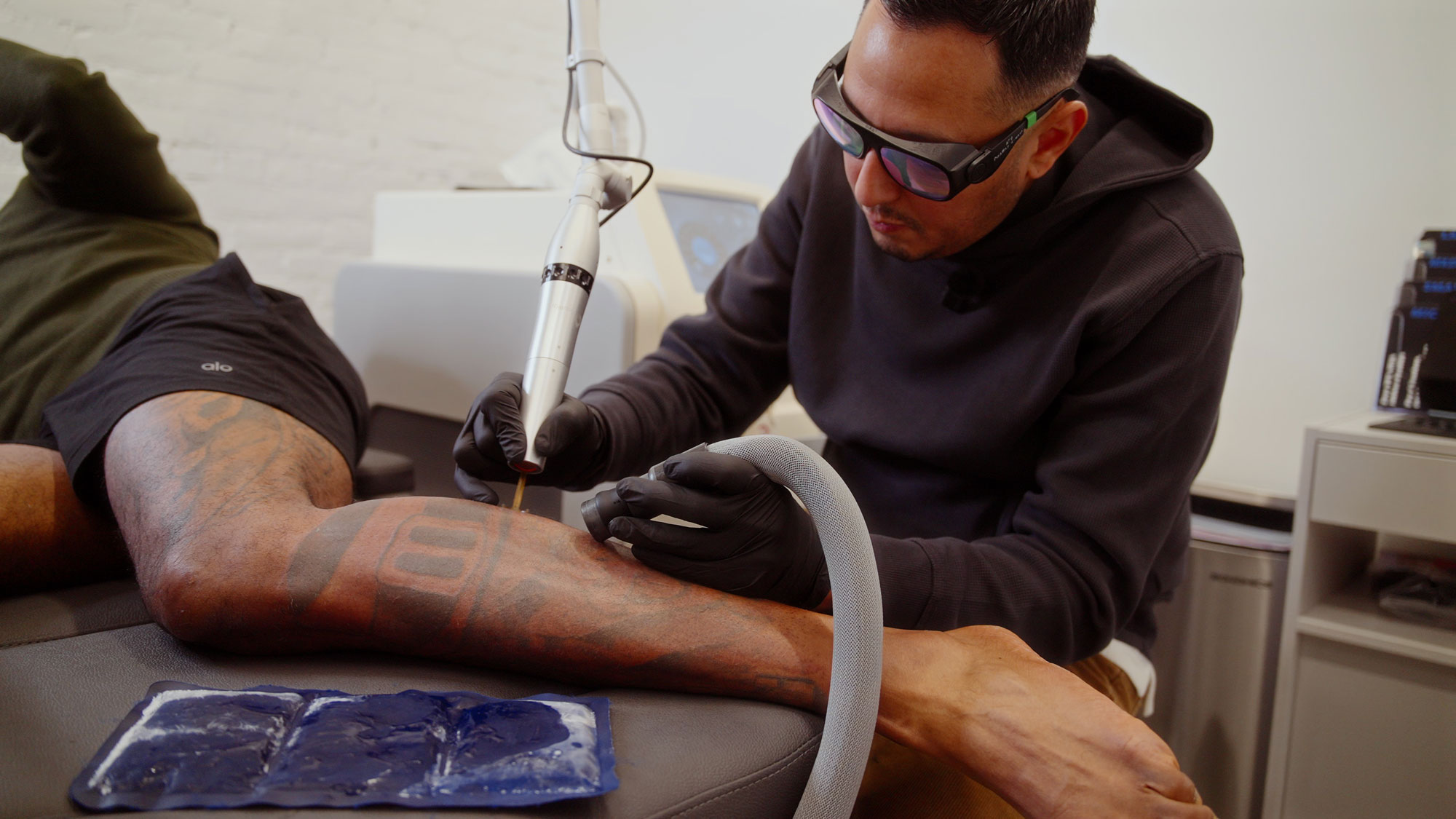
Multiphase tattoo removal methods such as the R20 technique and perfluorodecalin (PFD) patch treatments are frequently marketed as a faster way to remove tattoos by performing multiple passes in a single visit. These techniques are commonly promoted online because they appear dramatic on video, especially when surface frosting is reduced and the technician can continue lasering the same area repeatedly.
However, based on both clinical testing and the biology of laser-tissue interaction, multipass protocols do not produce superior clearance compared to standard single-pass tattoo removal. In many cases, they increase pain, extend healing times, and reduce treatment efficiency.
The reason is simple: surface frosting is not the true limiting factor in laser tattoo removal. The real limitation occurs deeper in the skin.
Why Tattoo Removal Becomes Ineffective After the First Pass
Laser tattoo removal works by delivering high-energy pulses into the dermis where tattoo pigment resides. During the first pass, laser energy is absorbed by pigment particles, causing rapid photomechanical disruption. This breaks the pigment into smaller fragments, beginning the removal process.
Immediately after this initial pass, the tissue undergoes optical cavitation. Cavitation is the formation of microbubbles and vacuoles within the dermis and epidermis caused by the sudden energy transfer and thermal shock.
These cavitation bubbles act like a barrier.
Once present, they scatter, refract, and reflect incoming laser light, reducing the amount of energy that can penetrate into the dermis where pigment still remains. This means that the second and third passes are not delivering the same effective fluence to the tattoo pigment as the first pass.
Even if the surface appears visually clearer, the internal tissue is still obstructing laser penetration.
Internal Cavitation Lasts 48 to 72 Hours
A major misconception in multipass techniques is the belief that frosting disappears quickly, allowing repeated passes to be equally effective. While surface frosting may visually fade in minutes, internal cavitation and tissue reaction can remain for approximately 48 to 72 hours.
During this time, the skin remains in a state where laser energy penetration is significantly reduced. This is why additional passes during the same visit offer minimal benefit.
No patch or topical device can eliminate internal cavitation once it has formed. The body must resolve that reaction naturally through time and healing.
Why PFD Patches Do Not Improve Results
PFD patches were designed to reduce surface frosting so technicians can visually continue treatment. The marketing claim is that reducing frosting allows the laser to continue penetrating and breaking down more pigment, therefore reducing the number of total sessions needed.
In practice, PFD patches do not achieve this goal.
Based on extensive testing, what consistently occurs is:
- PFD patches do not reduce the number of treatments needed
- They do not improve clearance rates
- They do not meaningfully reduce pain
- They can block laser penetration rather than enhance it
- They increase session duration without improving results
The patch has thickness and density, and functionally behaves like an expensive silicone barrier, similar to a hydrogel pad. Instead of improving laser delivery, it often interferes with it.
Clinically, frosting can often still be seen beneath the patch, confirming that internal tissue reactions remain unchanged.
Why Reduced Pain in Later Passes Is a Sign of Reduced Effectiveness
Many technicians mistakenly interpret reduced pain during second and third passes as a sign that the skin is becoming easier to treat.
In reality, reduced pain is often a direct sign that the laser energy is no longer reaching the deeper pigment.
Pain during tattoo removal correlates strongly with laser absorption by pigment particles in the dermis. When cavitation bubbles form, they scatter and reflect the laser’s energy. Less energy reaches the pigment, which results in reduced absorption and reduced pain sensation.
This is not increased efficiency. It is reduced penetration.
Why the R20 Method Does Not Provide Superior Clearance
The R20 method involves performing multiple laser passes in one session, with approximately 20 minutes of waiting time between each pass to allow visible frosting to dissipate.
Although the surface frosting may clear during the waiting period, internal cavitation remains present. The dermal tissue continues to scatter and reflect laser energy, which prevents later passes from delivering meaningful additional pigment fragmentation.
As a result, the R20 method generally produces:
- Increased skin trauma
- Increased inflammation
- Increased discomfort
- Longer healing time
- No measurable reduction in total sessions needed
The Main Problem With Multiphase Methods
The primary issue is that multipass techniques focus on surface visibility rather than internal tissue mechanics.
Tattoo removal is limited by what the dermis can absorb after cavitation occurs. Once cavitation bubbles form, the treatment becomes less efficient regardless of whether frosting appears reduced.
Because of this, performing multiple passes in one visit often creates unnecessary trauma without improving pigment clearance.
The client experiences more pain and more irritation, while the long-term fading remains the same as a properly performed single-pass session.
Recommended Clinical Approach
For the safest and most effective tattoo removal outcomes, the recommended protocol is:
- Perform one strong, effective pass per tattoo per session
- Focus on even coverage, correct wavelength selection, and safe fluence settings
- Avoid multipass techniques that increase trauma without improving clearance
- Schedule treatments 6 to 8 weeks apart to allow for dermal healing and lymphatic pigment clearance
- Treat multiple tattoos in one visit if desired, but do not repeatedly pass over the same area
This approach produces consistent long-term results while minimizing skin damage and unnecessary discomfort.
Why Standard Protocol Produces Better Long-Term Results
Tattoo removal is not limited by how much ink can be fractured in a single day. It is limited by how much pigment the body can metabolize safely over time.
The laser initiates pigment fragmentation, but the immune and lymphatic systems are responsible for clearing those fragments gradually. This process continues for weeks and months after each session.
The most effective strategy is to maximize the quality of each treatment pass while allowing the body the time it needs to complete the removal process.
Final Thoughts
Multiphase tattoo removal methods such as R20 and PFD patch techniques are heavily marketed because they look impressive in videos, but they do not provide superior clinical outcomes. Internal cavitation occurs immediately after the first pass and can last 48 to 72 hours, scattering laser energy and preventing effective penetration during additional passes.
Because of this, multiple passes in one session do not reduce the number of treatments needed and often increase pain, inflammation, and healing time.
For safe, predictable, and efficient tattoo removal, the most reliable approach remains a single-pass protocol with properly spaced sessions and individualized wavelength selection.
Related Insights


Let’s talk
Have a question about your tattoo or curious about your options? Send us a message and one of our experts will personally guide you toward the safest, most effective next step.
720-465-5377
Thank you! Your submission has been received!
Oops! Something went wrong while submitting the form.
