


Understanding Tattoo Removal Wavelengths: How Laser Light Targets Ink, Skin Pigment, and Depth
Subscribe to receive the latest Insights
Thank you! Your submission has been received!
Oops! Something went wrong while submitting the form.
Follow Us
Laser tattoo removal is often explained as “the laser breaks up the ink,” but the real science is more specific. The success of tattoo removal depends heavily on selecting the correct wavelength based on ink color, pigment chemistry, skin tone, and how deeply the pigment sits in the dermis.
When people ask why some tattoos fade quickly and others resist treatment, the answer almost always comes back to wavelength selection and absorption behavior.
This guide explains how tattoo removal wavelengths work, where they fall on the color spectrum, what they are absorbed by, and why different wavelengths are chosen for different pigment colors.
Where Tattoo Removal Wavelengths Sit on the Light Spectrum
Laser wavelengths are measured in nanometers (nm). The number refers to where that light sits on the electromagnetic spectrum.
In tattoo removal, the key wavelengths fall between the visible range and near-infrared range.
Visible light ranges roughly from 400nm to 700nm. Near-infrared begins around 700nm and extends beyond 1000nm. Infrared wavelengths are not visible to the human eye, but they still interact with pigment in tissue.
Tattoo removal wavelengths sit across this spectrum because different ink colors absorb different wavelengths of light.
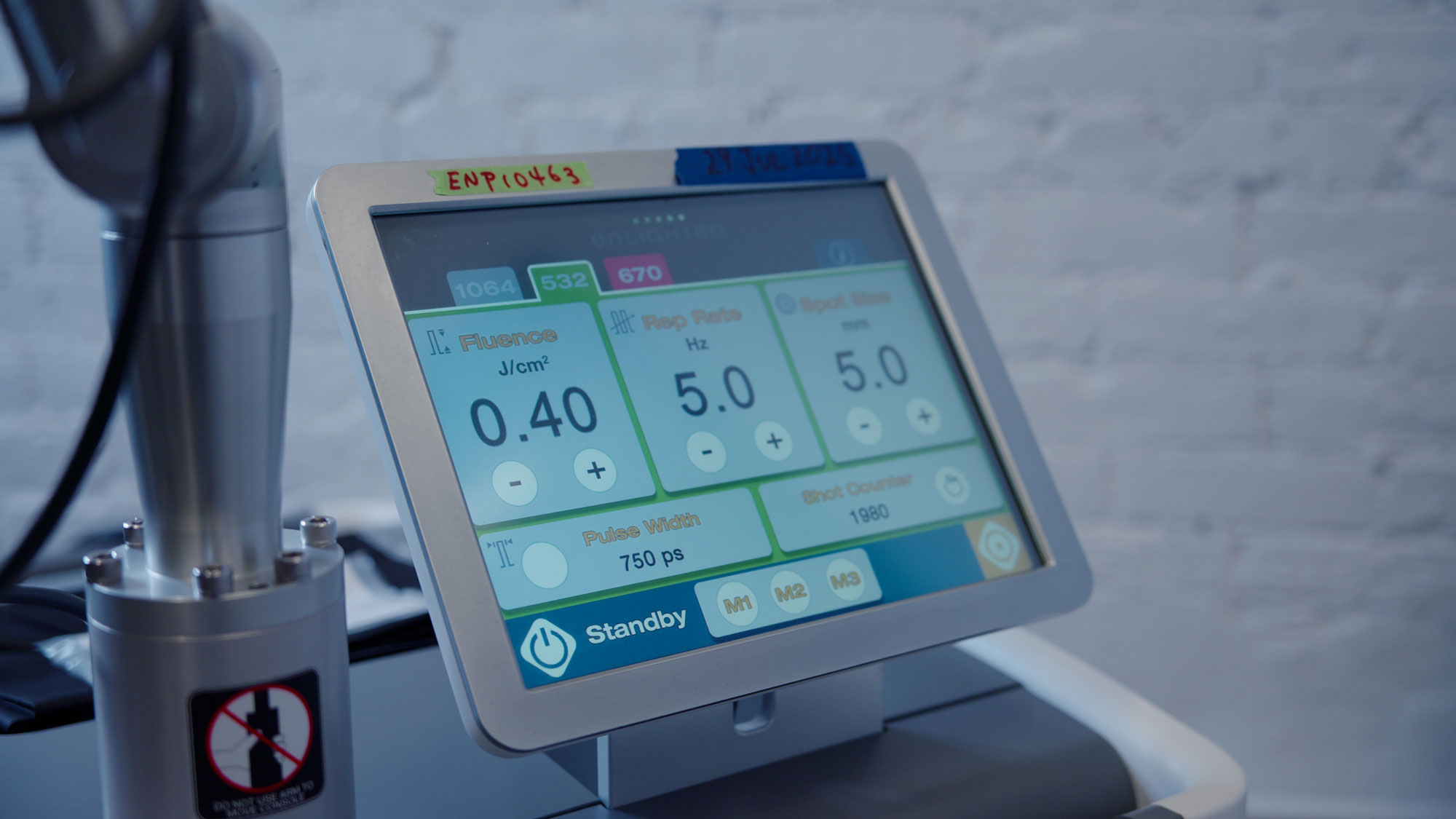
The main wavelengths commonly used in modern tattoo removal include:
- 532 nm
- 670 nm
- 730 nm
- 755 nm
- 785 nm
- 1064 nm
Each of these wavelengths interacts differently with tattoo pigments and with the skin’s natural chromophores.
What “Attracted To” Means in Laser Tattoo Removal
When someone says a laser wavelength is “attracted to” something, they are describing absorption.
A wavelength is effective when it is preferentially absorbed by a target chromophore.
The main chromophores involved in tattoo removal are:
- Tattoo ink pigments
- Melanin (natural skin pigment)
- Hemoglobin (blood)
- Water (tissue fluid)
Laser energy does not automatically target tattoo ink only. It is absorbed by whatever chromophore interacts most strongly at that wavelength. This is why wavelength selection is critical for both safety and results.
If a wavelength is strongly absorbed by melanin, it increases risk for darker skin types. If it is strongly absorbed by hemoglobin, it increases surface heating and potential irritation. If it is weakly absorbed by ink pigment, it may not produce effective breakdown.
532nm Wavelength: Warm Color Specialist
532nm is a green visible wavelength and is one of the most commonly used wavelengths in tattoo removal.
It is strongly absorbed by:
- Hemoglobin
- Red tattoo pigments
- Orange tattoo pigments
- Yellow tattoo pigments
- Some melanin
Because of its strong interaction with hemoglobin and surface pigment, 532nm tends to create more epidermal absorption and more surface heating. This means it does not penetrate as deeply as longer wavelengths.
This wavelength is highly effective for warm tones, but it requires careful protocols on darker skin types due to increased melanin competition and surface reaction risk.
670nm Wavelength: Transitional Red Spectrum
670nm sits in the deep red range near the edge of visible light.
It is absorbed by:
- Melanin (moderate)
- Certain tattoo pigments depending on formulation
Compared to 532nm, 670nm has lower hemoglobin absorption, meaning it produces less surface heating and can penetrate deeper into the dermis.
It is considered a transitional wavelength because it begins bridging the gap between warm-color targeting and deeper pigment penetration.
This wavelength can be effective for certain blue pigments depending on the ink blend and how the pigment absorbs light.
730nm Wavelength: Early Near-Infrared for Deeper Pigment
730nm sits in the near-infrared range.
It is absorbed by:
- Melanin (moderate)
- Certain tattoo pigments depending on formulation
Because it has lower surface absorption than shorter wavelengths, it generally penetrates deeper than 670nm and 532nm. It is often used when targeting pigments that require deeper penetration and reduced epidermal competition.
This wavelength is commonly associated with improving outcomes on certain green pigments, while reducing interaction with red and yellow tones.
755nm Wavelength: Alexandrite and Green/Blue Ink Targeting
755nm is a near-infrared wavelength commonly produced by Alexandrite lasers.
It is absorbed by:
- Melanin (high)
- Green tattoo pigments
- Certain blue ink formulations
This wavelength is well-known for being effective on stubborn green and blue pigments, which often resist shorter wavelengths.
However, 755nm has higher melanin interaction compared to other near-infrared wavelengths. This is why it requires extra caution when treating melanated skin types. Improper settings or aggressive use can increase risk of pigment disruption.
The 755nm wavelength can produce excellent fading results when used correctly, but it must be selected carefully based on skin tone and pigment response.
785nm Wavelength: Strong for Green and Blue with More Stability
785nm is another near-infrared wavelength often used in modern tattoo removal systems.
It is absorbed by:
- Melanin (moderate-high)
- Green pigments
- Certain blue pigment blends
785nm sits slightly further along the spectrum than 755nm. Clinically, this often provides more consistent depth penetration and slightly reduced melanin competition compared to 755nm, depending on the client’s skin tone.
Because hemoglobin absorption is low at this wavelength, it generally produces less surface interference and can target deeper pigment more efficiently.
This wavelength is often considered one of the strongest options for difficult greens and certain blues, but pigment formulation still plays a major role in predictability.
1064nm Wavelength: The Black Ink Workhorse
1064nm is an infrared wavelength produced by Nd:YAG lasers and is the most widely used wavelength in tattoo removal.
It is strongly absorbed by:
- Black tattoo ink
- Dark pigments
It has relatively low absorption by melanin compared to 755nm and 785nm, which is why it is considered the safest wavelength for darker skin types.
It also has minimal interaction with water at this range, which helps maximize depth penetration and reduce unnecessary tissue heating.
1064nm is widely considered the deepest penetrating tattoo removal wavelength, making it ideal for:
- Black ink
- Dark gray shading
- Deeply embedded pigment
- Tattoos on thicker skin areas
While 1064nm is highly effective for black ink, it has low interaction with many bright colors, which is why multiple wavelengths are needed for full-spectrum tattoo removal.
Why Black Ink Absorbs So Well Across Multiple Wavelengths
Black pigment is often described as a broad absorber. This means it absorbs energy across a wide range of wavelengths, from visible light through near-infrared.
This is why black ink often responds to many laser wavelengths. However, it responds best to longer wavelengths such as 1064nm because those wavelengths penetrate deeper with less surface competition from melanin and hemoglobin.
This is also why black tattoos often fade faster than colored tattoos when treated with the correct laser system.
Why White Ink Is So Difficult to Remove
White ink, especially titanium dioxide-based pigment (TiO₂), behaves differently than most tattoo pigments.
It has weak absorption across the laser spectrum. Instead of absorbing energy, it scatters light. This means the laser does not effectively break it down in the same way it breaks down darker pigments.
This explains why white ink often:
- Does not clear well
- Appears resistant to treatment
- Can paradoxically darken after laser exposure
The darkening effect is typically caused by chemical or optical changes rather than true pigment breakdown.
This is why white ink removal requires advanced protocol, and why some white pigments may never fully clear.
This is the foundation of why wavelength selection matters. It is not about laser power alone. It is about matching wavelength to pigment absorption.
Practical Summary of Wavelength Use
The most important takeaway is simple.
Shorter wavelengths such as 532nm are best for warm colors like red, orange, and yellow. Mid-range near-infrared wavelengths such as 730nm, 755nm, and 785nm are typically best for green and blue pigments. Longer wavelengths such as 1064nm are best for black and dark pigment, with the deepest penetration and the lowest melanin interaction.
Tattoo removal is governed by pigment absorption curves competing with skin chromophores.
Final Thoughts
Understanding tattoo removal wavelengths is one of the most important parts of achieving safe and effective results. Every wavelength interacts differently with tattoo pigment and with the body’s natural chromophores such as melanin, hemoglobin, and water.
The best tattoo removal results come from selecting the correct wavelength for the pigment color, choosing safe settings for the client’s skin type, and allowing the body enough time to metabolize broken-down pigment between sessions.
When a clinic uses multiple laser wavelengths and applies them correctly, the removal process becomes safer, more predictable, and far more efficient across the full range of tattoo colors.
Related Insights


Let’s talk
Have a question about your tattoo or curious about your options? Send us a message and one of our experts will personally guide you toward the safest, most effective next step.
720-465-5377
Thank you! Your submission has been received!
Oops! Something went wrong while submitting the form.
